Swatch Nines Waco 2026: Skate and BMX Lines Meet Surf
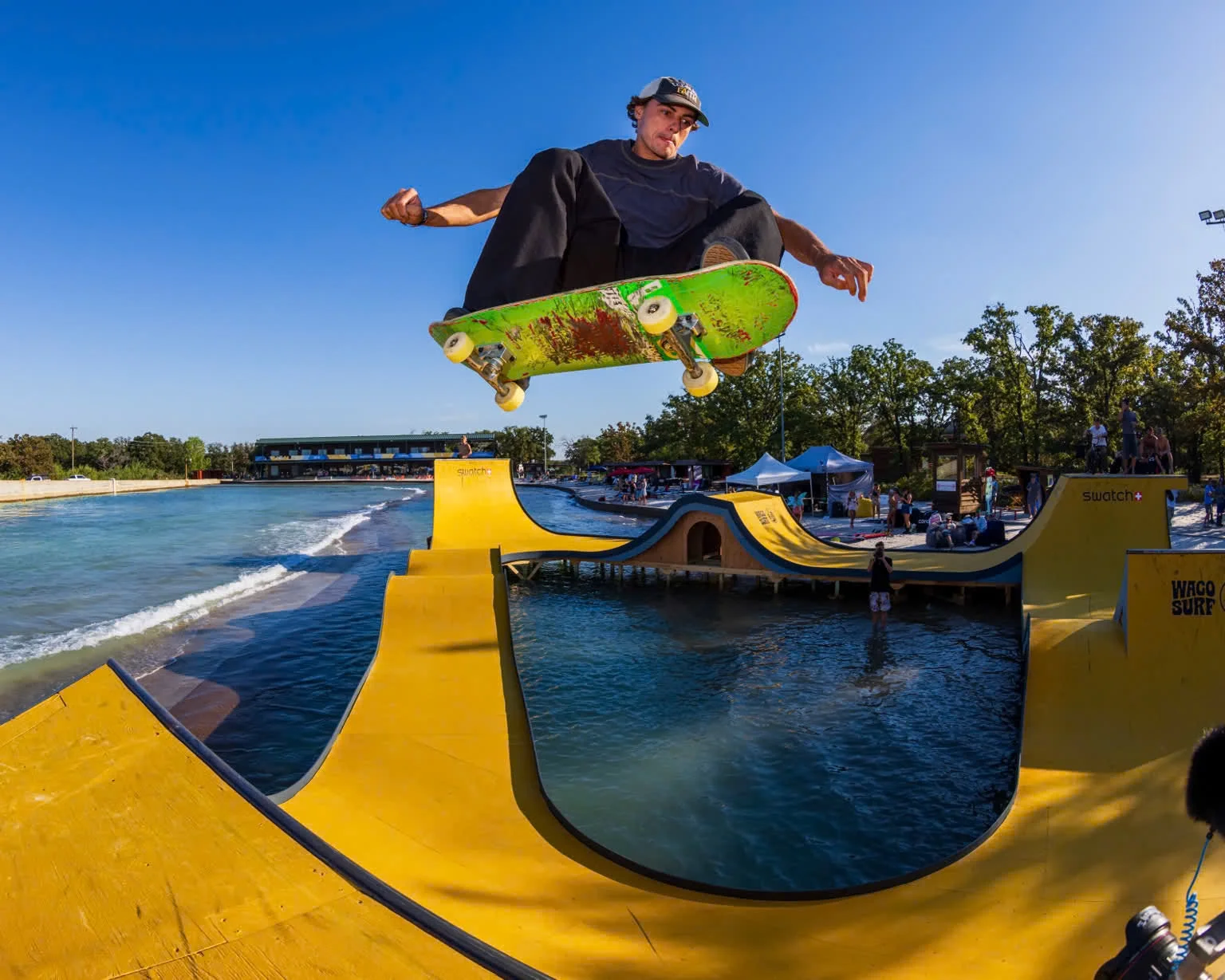
Swatch Nines’ Waco event made its strongest case yet for designing across sports: a skate course built over water, a wave pool below, and features shaped by riders’ own ideas. Across three days at Waco Surf, surfers, skateboarders and BMX riders tested new lines and tricks in a setup built for experimentation rather than competition. That distinction shaped the event. Without a contest format directing attention toward a single result, the course itself became part of the performance: riders could explore how its sections connected, and organizers could see which design ideas held up in use.
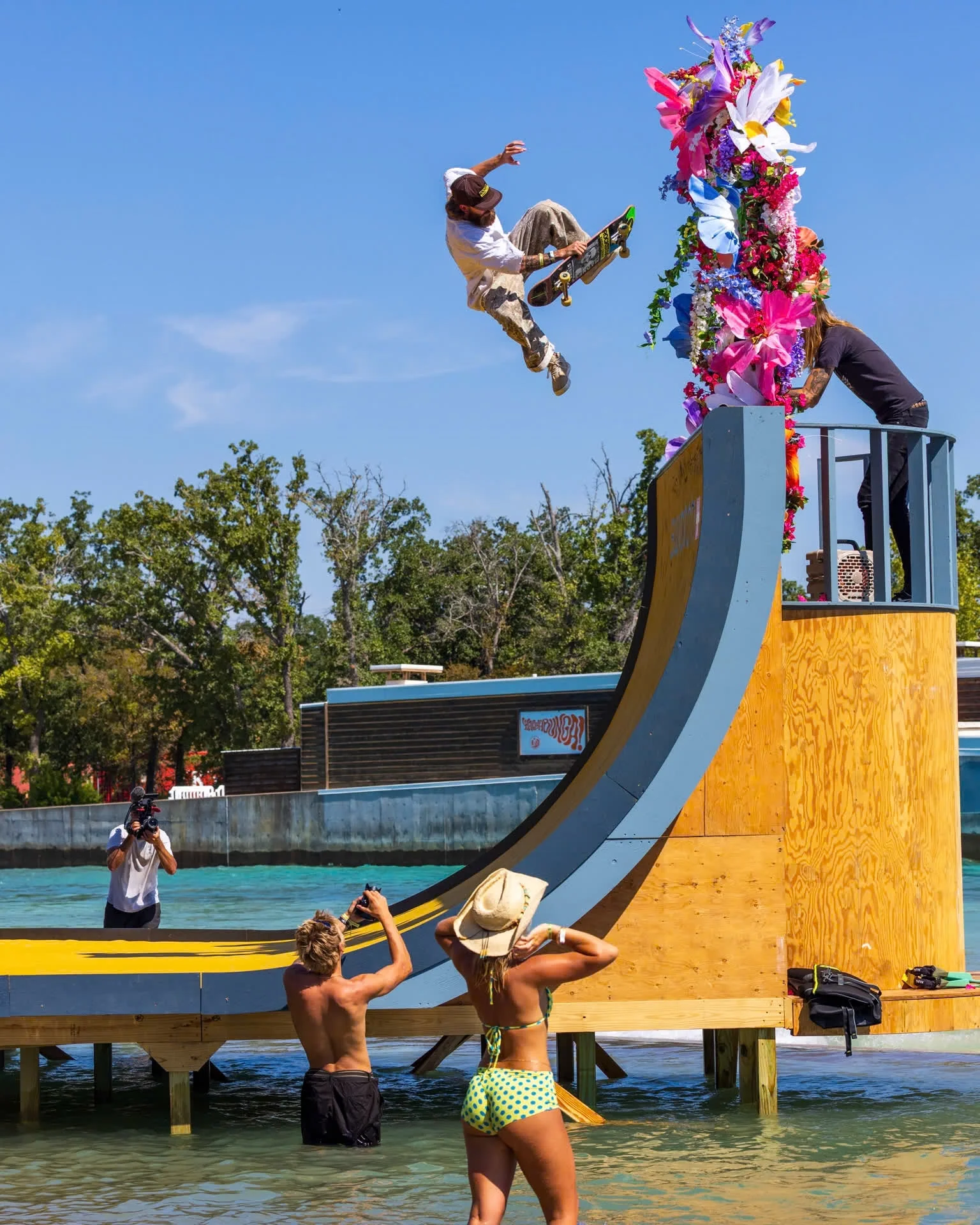
A connected course invited new lines
The skate setup had grown considerably since the event’s first year, when its central feature was a pipe. This time, spines, quarters, hips and rollers formed a continuous course above the water, giving riders room to connect sections in their own way. That kind of layout changes the task: a feature can be a trick in itself, but it can also set up the next turn, jump or landing. Riders had to read the course as a sequence, not a collection of isolated obstacles. The Flying O returned, while a mirror feature challenged skateboarders and BMXers to work flat-ground tricks against their reflections as surfers rode below.
The format produced a string of standout moments. Dalton Dern landed a 540 on Thursday, then aired into the shallow end of the pool and rode away. Adam Hopkins also put down a 540 on the vert quarterpipe, and Yurin Fujii kickflipped Indy over a roller. Shane Borland drew attention with his ramp lines; Gustavo Ribeiro linked a line through the reception area; and Alex Midler kickflipped backside tailslide over the steps. Those moments show how much the setup depended on riders finding different uses for its transitions and gaps. A demanding test. First-time Nines participants Curren Caples and Brandon Valjalo added to a deep skate field.
Blair Alley
“The Waco setup is insane. There’s nothing like surfing and skating all in one zone,” Midler said. “Having the best in the world at each sport in one place pushes what’s possible. Seeing people try new tricks and do things they didn’t think were possible is a recipe for innovation.” The quote gets at the event’s central proposition: put athletes from different disciplines close enough to watch one another, and the shared setting may encourage experimentation. That’s an appealing idea, though the real measure is whether the course gives riders practical reasons to try something new. The reported tricks suggest it did.
That shared environment was also the point of the course design. Concepts from the previous winter’s Creative Cabin workshop were turned into physical features by the Zenga Bros, who worked from athletes’ ideas and the practical demands of the site. This process connects the sketching stage to the finished riding experience: athletes can propose a feature, while builders have to account for how it fits the space and can be used. The result let surf, skate and BMX shape one another’s experience, with the wave pool and elevated course operating as parts of the same venue. It’s a more demanding design brief than building for one discipline, because a feature must make sense within a broader setting.
Public day brought fans onto the beach
More than 300 people came to Waco Surf’s beach on Saturday afternoon for the public day. They could see the custom builds up close, watch the athletes use them and meet riders who’d travelled in for the event. Some guests also joined Nines riders on Waco’s new Shredmill. For spectators, that access offered a view of the course as a physical object as well as a backdrop to tricks; the scale and arrangement of features can be easier to understand from nearby than through a highlight edit. Here's the thing: an event designed around experimentation still needs an audience able to follow what the experiments look like.
Swatch Nines doesn’t run as a contest, but riders gathered on the final night to recognize performances and creative contributions. The 2026 awards went to:
- New Nine: Makana Franzmann
- Best Skater – Female: Yurin Fujii
- Best Trick Skate – Male: Clay Kreiner
- Special Skate Award: Andy Anderson
- Best Trick Surf – Female: Milla Coco Brown
- Best Trick Surf – Male: Noah Beschen
- MVP – Female: Yurin Fujii
- MVP – Male: Shane Borland
The awards add a layer of recognition to a format that doesn’t rank riders through a conventional contest. Categories for best trick, MVP and a special award can draw attention to different kinds of contribution, though they don’t turn the event into a scored competition. Yurin Fujii’s two awards, for Best Skater – Female and MVP – Female, stand out in this year’s list. That said, a short awards list can only capture part of what an event built around trying things has to offer.
What the format says about the event’s future
Swatch Nines’ Waco setup makes a case for treating course design as a central part of an action-sports event, rather than simply the stage beneath it. The strongest evidence here is the combination of rider input, custom-built features and reported moments that used the course in varied ways. This is more significant than it looks: the design determines what kinds of attempts are possible, while the format gives athletes room to pursue them without a contest result setting the terms. The article doesn’t establish how the event will develop, but the Waco model points toward a clear question for future editions: can organizers keep making shared spaces that feel useful to each sport while still encouraging riders to cross familiar boundaries?
If you’re working in this space, the practical lesson is that collaboration has to reach the build itself. Inviting athletes to contribute ideas matters most when those ideas survive contact with the site and become features riders can actually use. And yet, a striking design alone can’t guarantee new tricks or lasting influence; those depend on what athletes choose to do with it. The event’s public day and video releases help carry those attempts beyond the beach, giving fans more ways to see the course and the riding. (And this is the part most people overlook: the design is also a way of shaping what the audience gets to watch.)
Event footage is available on YouTube.com/@SwatchNines, with a full highlight video due early the following week. Updates are posted at @thenines.cc on Instagram. The Couch Surfing Show aired October 8 and 9 on YouTube, where viewers can also find a replay with rider commentary. That material gives the event an afterlife beyond the three days at Waco Surf: viewers can revisit the attempts and hear riders explain them. It’s a useful complement to the live setting, where the appeal lies partly in seeing what happens when athletes encounter a course built to invite a different line.